This is an article from last weekend's Sunday Times written by Richard Oakley, reproduced here with kind permission of The Sunday Times. I will be linking here from Team Geared Up.
Mission Possible:
This weekend in a tent high up on treacherous Mount McKinley in Alaska,
an Irishman is preparing to set a world record. Ian McKeever, a lecturer
from Bray, Co Wicklow, is about to shatter the fastest time for reaching
the top of the seven highest mountains on each continent.
His quest began on January 25 when he stood on top of Mount Vinson in
Antarctica. Since then he has climbed Aconcagua in Argentina,
Kilimanjaro in Tanzania, Carstensz Pyramid in Indonesia, Everest in
Nepal and Elbrus in Russia. Early this week, possibly tomorrow, he
should make it to the highest point in North America and shatter a
record set last year by Daniel Griffith, a Canadian, of 187 days.
Six months of gruelling and exhaustive climbing, six months of living
out of a rucksack, more than 40,000 vertical metres climbed and McKeever
should break the record by a month.
Such is his speed he even has time to claim another world title. There
is a combination of the seven summits that substitutes Mount Kosciuszko
in Australia for Carstensz Pyramid as the highest mountain in Oceania.
Succeeding on either peak, plus the other six, is enough to complete the
challenge. McKeever has the chance to set the fastest time for both.
The record, with Kosciuszko, was set last year by Mastan Malli, an
Indian, who completed it in 171 days. McKeever has until July 15 to
reach the top of this comparatively easy 2,228-metre peak.
By any measurement what he is about to achieve is extraordinary, but it
is all the more so given his ordinariness. He only turned to
high-altitude mountaineering last year and his previous experience
amounted to running to the top of much smaller mountains. He was part of
a team that set a record for completing the five highest peaks in
Britain and Ireland in 2004 and the following year he scaled Croagh
Patrick in Mayo seven times in 17 hours to set a record for the most
mountains climbed in the fastest time.
As McKeever completes his most difficult speed challenge yet, he joins
the growing list of Irish people who have tackled extreme challenges in
a bid to reach personal goals and set records. He joins an expanding
club of people who achieve impressive, sometimes barmy, firsts taking on
adventures that others were glad to survive. Years ago, climbing the
seven summits was the target. Now the challenge is doing it in the
fastest time. With world firsts apparently running out, what on earth is
left to achieve?
"WHEN I started doing what I do, there were very few Irish people
involved. Now there are loads," said Mark Pollock from Holywood in Co
Down, whose hobby is running marathons in some of the world's harshest
environments.
"Years ago, people just wanted to get to the North Pole. Now you can fly
in and run a marathon. The world is smaller, equipment and techniques
are better and there are more opportunities for ordinary people to get
involved. Irish people are being tempted to train and undertake
challenges instead of going to the pub," he said.
Other Irish people are excelling in Pollock's chosen sport. Five years
ago Richard Donovan, a Galway ultra-runner, won the South Pole marathon
and then ran another at the North Pole, becoming the first person to
complete the distance at both ends of the Earth.
Pollock set his own record recently when he became the first blind
person to complete the Everest marathon, the highest in the world, and
the Dead Sea marathon, the lowest. A former international rower, he lost
his sight in 1998 at 22. Both runners have received acclaim for their
achievements, but such feats are beginning to fail to attract much media
attention. With more people completing challenges, those seeking to
reward sponsors or drum up publicity need angles to sell to the media.
The international competition is fierce. Last October, Kit DesLauriers,
an American, became the first woman to climb all seven summits . . . and
ski down them afterwards. Last month, Bear Grylls, a British adventurer,
was the first person to paraglide a lap of Everest's summit and William
Tan, a 49-year-old from Singapore, completed the Arctic marathon in a
wheelchair. When Dawson Stelfox became the first Irishman to climb
Everest in 1993 it was a huge story, but now Irish people who reach the
top of the world can do so almost anonymously. Around the same time
McKeever topped out on Everest in May, three Irish doctors reached the
summit, as did Hannah Shields, the first woman from Northern Ireland to
do so. The number of Irish people to have climbed Everest is still less
than 20, but their achievements merited only passing mention in the
media.
"The exploration element of adventure is dying away now," said Damien
Hackett of Outsider magazine. "It's about the first person with a
plastic hip to climb Everest or the first person with one eye facing up
and one facing down to do it. It has got to that stage."
What were once extreme challenges into the unknown, he said, are now
more mainstream with companies providing guides and facilities for those
who can afford them. McKeever was sponsored by Ulster Bank and used the
services of Adventure Peaks. It has plenty of experience bringing paying
clients to the top of the seven summits and sorts out logistics,
porters, food, supplies and equipment for mountaineers. It recently
helped two 19-year-olds become the youngest Britons to climb Everest and
last year it aided Jake Meyer, a 21-year-old, to become the youngest man
to complete the seven summits. Mike Barry, the first Irishman to walk to
the South Pole and who was part of the Irish team on Everest in 1993,
agrees there has been criticism of this style of mountaineering and of
records set in this way.
"The key to mountaineering is to be self-sufficient, to survive and
climb in harsh conditions where you are fending for yourself. To explore
places people haven't been," he said. "Some people still climb in this
way and others go the more commercial route. You rarely hear about the
former, because to them it's a way of life. It's just something they
do." So with enough money, time and help can anyone achieve what
McKeever has? Not really, Barry says. "What Ian is doing involves
endurance, stamina and commitment. When I heard what he was doing it
sounded so difficult. I thought there was no way he could do it, but it
looks like he will now.
"One go at any of those mountains would be hard on the body. Doing them
all in the way he did is outstanding." Pollock is also impressed. "I
think it takes a lot of guts to take on a challenge like this," he said.
"To tell everyone in the world that you are going to do it and then
actually do it. You are putting yourself under pressure to achieve what
is already a difficult goal." Pat Falvey, the first Irishman to climb
the seven summits, argues there are serious mountains involved,
especially McKinley. "Ian deserves credit. People talk about the seven
summits being completed by lots of people now, but they are missing the
point. Just because people have climbed Everest ahead of you doesn't
take away from the feeling you get when you stand at the top having
achieved your goal."
TeamGearedUp.com, an adventure blog, covers stories about new world
firsts. One of its founders, Robin Blanford, agrees that the number of
original challenges is dwindling. "In mountaineering we've stood on all
the peaks - at least the significant ones. There are still plenty of
unclimbed mountains, but in terms of firsts what you are seeing is more
people climbing the same things by more difficult routes in faster times
or more unique ways," he said.
According to Barry the "unknown" still exists for more serious
adventurers, but in far-flung places. There are some records waiting for
Irish people, such as being the first to climb K2.
Donovan and Falvey say the future challenges lie at the poles. Donovan
is planning to become the first to run across the Antarctic next year, a
2,500km trek that will involve running a marathon a day for 50 days. "I
wouldn't want to do it if someone else had," he said. Falvey intends to
make it to the South Pole and may also traverse the Antarctic because "I
want to see if I can do it". Elsewhere, other people are inventing new
firsts of their own. Wim Hof, a Dutch iceman, will attempt to climb
Everest from the north side this year wearing only shorts. In Ireland a
group of athletes are trying to run 120km, including 27 peaks, in less
than 24 hours. The Wicklow Round was conceived by mountain runners last
year and has never been completed.
Karl Bushby, a 38-year-old former paratrooper from Yorkshire, hopes to
become the first person to complete an unbroken walk around the world.
His website quotes a foreword from his book, Giant Steps, in which
Frederick Forsyth writes: "There are virtually no undiscovered places
left to find, no unclimbed mountains to scale, no new rivers to cross.
It seems there may be no challenges left to face."
As he sets off to complete the seven summits challenge tomorrow morning
or on Tuesday, McKeever would beg to differ.
copyright: The Sunday Times.
Wednesday, June 27, 2007

Tuesday, May 29, 2007
Tony's Account of the Round - Copied from IMRA Forum
The Wicklow Round
My thoughts
First of all I’ll cut to the chase!
The round is 100% achievable in its current route, for most of us Joe Soap’ers the 24hrs is probably not do-able, but for a select few with proper training, planning, logistics, support, good weather and other factors that will become apparent below I believe a sub 20hrs can and will be done.
The round is by its very nature a difficult and daunting undertaking, but then as the cliché says ‘If it were easy everybody would do it’, when was the last time any mountain run was easy?!
I have checked the route both by Garmin GPS and by the OSI digital mapping package, I have got it on both methods at circa 122k. Give or take GPS inaccuracies and some route changes the overall distance of the round may be more like 118k as apposed to 100k.
Taking all this aside, the ‘route is the route’ and I firmly believe that the course should stay as is and not be altered or shortened in any way, you must bring yourself up to the level of the course and not try to bring the course down to your level.
As most of you will know by now 5 of us took on the challenge last Saturday 26th May, we started at 2.00am and had to make a difficult and somewhat emotional call 18 ½ hours and 84k later at 8.30pm to call a halt, this is our account …….
Ever since Joe Lalor and Brian Bell conceived and announced the Round at last years IMRA AGM It has captured my imagination, not because it’s an organised race with all its trappings, but because its completely left up to the individual or group to organise, plan and undertake this challenge. And to be honest the chance of being the first to complete really spurred us on.
Planning :
I am going to be deliberately sketchy on route choice, as a group we have decided that anybody looking for advise on route choices should carryout their own reccee first and then we will offer our advice if requested.
Part of the fun and challenge is finding your way!!
We broke the round up into 3 sections to be receed,
Section -1 :
Kippure (Starts where the handicap race starts ) to Ballinagee Bridge on the Wicklow Gap Road.
Distance circa 32k.
Reccee time 5hrs 20min.
This section takes you out on some of the most remote and boggy sections of Wicklow, there are no quick exits off this area, no ‘Yellow Brick Roads’ to take you off should your find yourself in problems. You need to take all precautions when recceeing this section.
In saying that there is a general walkers path through 30% of it.
We receed this section in late April in glorious sunshine, perfect visibility and the going was very good as it hadn’t rained for weeks. We all ran out of water towards the end, there are no good streams to drink out and you should bring a 2lt camelback.
In fact there was one section of burnt gorse that was still warm underfoot as you ran across it!
We also broke into two groups taking different routes through sections to see which way was quickest.
Section-2:
Ballinagee Bridge to Glendalough :
Distance circa 45k.
Reccee time 8hrs 15min.
(I got my car broken into at Ballinagee Bridge during this recee.)
This section can be further broken down to finish at 1) The Wicklow Way Leg-6 where it crosses over the main road, or 2) Drumgoff.
Once again we receed this section in glorious sunshine and perfect visibility. The going was very good as the bog was firm and dry.
Two sections need a bit of carefull navigation :
1) Oakwood to Table Mountain
2) Carrawaystick over Slieve Maan (you will need the Glenmaulure Map for this section).
Once again it is very easy to run out of water and again no streams to drink out of if your stuck.
We stopped in for a well deserved Locuzade and Coke from the bar in Drumgoff, the taughts of which kept us going for ages!
You complete the marathon distance of 26.2 miles on this recee section just as you reach the Derrybawn summit !.
We left out a section over Camdenderry and Tonlagee as we felt we new this section well enough (or so I taught!!)
Section-3:
Glenmacnass Waterfall Carpark to Kippure (Finish):
Distance circa 42k.
Reccee time 8hrs 20min.
This homeward section creates many various route choices with no major difficulties.
The beauty of this section is that because its close to home we did a couple of minor evening reccees to tighten up on some of the more tricky parts, the route off Lugala and from Tonduff to Prince William Seat , now there’s a dilemma!!.
Also we double checked the route off Knockgun back to the Fetherbeds as it’s not that straight forward.
Things to plan / consider for your reccee:
1) As noted you must tackle the whole of Section-1 from Kippure to Ballinagee bridge in one go so be well prepared, all the rest can be done in smaller sections.
2) Forget about OSI -56 map, you need Harveys and Glenmaulre map.
3) Know how to read a map and use a compass, practice.
4) Be careful when shuttling and leaving your cars due to break-ins. We got someone to drive us out and collect us for the end section.
5) Bring plenty of water and food.
6) Buy yourself a good paclite gortex waterproof jacket!
7) Carry first aid kits and mobile phone.
8) Bring a good Altimeter, I found this invaluable to check your position against contour lines and maintaining height.
9) Bring spare gear, especially socks as your feet will get very wet.
10) Buy the OSI Digital Mapping package, I found the photographic surveys invaluable to check and confirm that a route or path shown on a map actually exists !, note with all the deforestation going on its a bit out of date.
11) Try teaming up with a bunch of like minded and easygoing individuals, these recess take a long time so you need to have a bit of fun and crack as you go along.
12) You need to establish one primary navigator in the group with one or two in back-up.
13) Consider using and practicing using trekking poles for the later sections to ease the stress on the legs.
14) Get yourself a pair of mountain running gaitors, these stop a lot of crap getting into your shoes and help prevent blisters.
15) After you have done your recees tap into the vast wealth of experience in the IRMA community for route advise, no two will agree !!!.
16) Pray for good weather.
Planning for the big day!
We picked Sat 26th May to start at 2.00am, we had hoped to complete in under 24hrs based on our reccee times, more of that later. There was also a 66% full moon planed for the 26th.
The group had a meeting with our support crew a week before the off to plan the Logistical Support Stops, 6 stops in total.
These support stops included, hot food and drinks, replenishment of energy bars, gels and drinks for the next stage, change of clothes and runners, also carry sets of trekking poles and spare head-torches.
It also provide transport and aid in case somebody got injured or had to pull out.
We treated this challenge as you would plan for a marathon and Carbo Loaded until it comes out of your ears, along with spending the week drinking copious amounts of water.
I also drove our Logistical Support supremo Bronagh Ni Bhriain around the course to show her exactly where to meet us.
However, you must be prepared to be self sufficient in case a support stop is missed, car breaks down etc.
We also had to arrange for a Lift / Taxi to the start for 2.00am and for somebody to collect us after we (hoped to) completed in the small hours of Sunday morning.
The big day arrives:
Well after months of planning we arrived at the start at 1.30am to be met by Brian Bell, the temperature gauge on the car showed 2deg. Thank god we all brought gloves and head scarfs.
When was the last time you wore gloves at the end of May?
Anyway, my initial fears where abated as I could see the Kippure mast flashing away assuring me that there was no mist on the hills ……..
5,4,3,2,1 and we’re off,
I had brought a small hand torch along with a head torch to help pick up the track upto Kippure. About 500mts from the top, Mother Nature made her first appearance of the day by completing closing in with freezing hill fog, visibility was down to about 10mts but we all new the route and made it to the top only 1min behind schedule.
Onwards up to Carrigvore was also relatively ok until we meet this fog bank again, when we got to the top there was virtually zero visibility.
I made a navigation error here and within 10min found ourselves stopped dead with no visible signs of the ditch to the base of Gravale that we had ran through without a care 4 weeks earlier.
The fog was so dense; it was one of those ‘Scooby-Doo’ moments where your torch light beam is all that penetrates the darkness.
This is where the Garmin Altimeter earned every penny it cost, we where able to check our exact height against the map contours and eventually found the ridge up to Gravale. We had lost circa 30min here and our hopes of a sub 24hr time was fading fast.
One of the problems of navigation in this weather and terrain is you have to zigzag around and up-and-over peat hags and its very difficult to maintain a straight line bearing from your start point.
If anybody has any advice on this situation I would be very interested to hear.
What we learned:
1) Double or triple reccee sections to be done at night.
2) A clear sky in Dublin is no assurance as to clear sky’s / visibility in Wicklow.
3) Try to keep a cool head in poor visibility, check and double check compass bearings.
4) Some of the team got very cold when we stopped moving, you need to bring extra clothing.
5) We may have had to stay put until sunrise or until the fog cleared, we had no group shelter or bivvi bags (we all had survival blankets). The next time we will have all 3.
From there onwards to our First Support Stop we found our way ok, the dawn broke at around 4.15am and this lifted our spirits.
What was becoming very apparent with every step we took was that the ground / bog conditions where very different to what we experienced during our reccees. What was initial good fast conditions under foot has turned into very heavy and slippy bog. There was much more tooing and frowing to get around large section of bog water pools that weren’t there 5 weeks ago.
Anyway, as I said the course is the course so we got on with it , eventually reaching Joe Lalor and John Cullen of Tallaght AC at 7.40am about 50min outside our schedule.
At this stage nobody gave 2 fxxxs about the time we all where just buoyed up to finish.
From been a chilly 2deg’s at Kippure it was now a lovely morning with jackets, hats, leggings and head torches packed away prior to the long slog upto Oakwood.
From Oakwood all the way around to Lugnaquilla and then onto Cronaghanmoira we made good and steady progress, weather was good with a slight cold south westerly wind.
Anyone giving the round ago should take care navigating from Oakwood to Table Mountain via the 3 Lakes as this could prove nasty in bad weather with plenty of peat hags and stream cuttings to hamper navigation.
Aisling found a € 5.00 in the bog near the 3 Lakes ( anybody loose it out there ?) we taught this was to be a lucky omen .
It became apparent that our overall timings where starting to slip as the day passed, what we didn’t factor in was ; 1) The cumulative effects of fatigue and 2) The wet and heavy bog conditions.
When we eventually ran into Drumgoff we where 1hr 30min behind schedule but no one cared, we where just happy to meet our first Hot Food stop after circa 12hrs on the go.
How to manage a proper Logistical Support Stop:
At this stage we would like to thank Bronagh, Karen, Grainne and Eoin for their fantastic and well set up support :
1) Orders where taken for Hot food and drinks at the road crossing up to Croaghanmoira, this was then ready by the time the team got into Drumgoff.
2) All our spare clothes, food and drinks were laid out ready for us when we arrived, we didn’t have to waste time or route through a car boot looking for our kit.
3) Hot coffee, cupa-soups and drinks ready and laid out on a camping table for us.
4) They also took off our bags and refilled our camel backs.
At this stage all 5 of us opted for the Trekking Poles as we pushed on to Mullacor and onto Derrybawn where we were met by Paul and Isabelle, it’s the little moments like this when you see a friendly face that lifts your spirits and gives you a further kick to go on.
While going up Mullacor we felt the first signs of rain and our luck turning for the worst. I had been tracking the cloud cover for a while and mist and low clouds could be seen rolling down the Glendalough Valley.
Now for the worst climb of the day, up Camederry, straight up the hill (not by the race route), by the time we got to the top the rain was falling steady and ground conditions underfoot where gradually getting worse.
As for Tonelagee, this was like walking up a never ending swamp all the way up to the summit; strangely enough the summit was very clear but with visibility very poor below.
Coming down off Tonelagee by the rocks was fairly hairy as they where very wet and slippy.
Also the route down along the ridge would normally be runnable / shuffle-able but it was sodden and extremely slippy underfoot.
Overall I totally underestimated the time taking to get from Glendalough to Glenmacnass by the time we got down to an emotional cheer from well-wishers at Glenmacnass we were about 3hrs behind schedule, looking at circa 28hrs to complete.
Getting into Glenmacnass we had travelled circa 84k in 18+1/2 hrs and to be honest we where mad keen to keep going.
It was now 8.30pm with only 1hr of day light left and the weather had totally closed in with no visibility up to Scarr. A decision had to be made, do we push on into the night across some fairly tough terrain in atrocious weather or do we pull the plug and live to fight another day.
Brendan Lawlor had rolled into town with his soup kitchen which was very well received and warmed us up.
Our team had a group meeting inside his van and the decision was made to pull the plug.
On a personal level I was gutted not to have finished as where the rest of the team, unlike an organised race, the round will always be there.
And yes we have already made plans to given it a go in the very-very near future, certainly before the end of the summer.We are changing our start time to and being more realistic on our schedule timings.
As to be the first to complete it, I am not too bothered about that now, its much more personal than that; our team just want to finish ………
To sign-off, on behalf of our team I would like to thank both Joe Lalor and Brian Bell for putting together this challenge.
For all inspiring ‘Rounders’ I hope this account gives you some insight into what you’re up against.
As for rumblings of a Wicklow Round Relay, I don’t believe this is in the spirit of the Round but that for another discussion.
Tony Kiernan
The Team : Aisling Coppinger
Niall Coppinger
Liam O’Riain
Gary Moralee
My thoughts
First of all I’ll cut to the chase!
The round is 100% achievable in its current route, for most of us Joe Soap’ers the 24hrs is probably not do-able, but for a select few with proper training, planning, logistics, support, good weather and other factors that will become apparent below I believe a sub 20hrs can and will be done.
The round is by its very nature a difficult and daunting undertaking, but then as the cliché says ‘If it were easy everybody would do it’, when was the last time any mountain run was easy?!
I have checked the route both by Garmin GPS and by the OSI digital mapping package, I have got it on both methods at circa 122k. Give or take GPS inaccuracies and some route changes the overall distance of the round may be more like 118k as apposed to 100k.
Taking all this aside, the ‘route is the route’ and I firmly believe that the course should stay as is and not be altered or shortened in any way, you must bring yourself up to the level of the course and not try to bring the course down to your level.
As most of you will know by now 5 of us took on the challenge last Saturday 26th May, we started at 2.00am and had to make a difficult and somewhat emotional call 18 ½ hours and 84k later at 8.30pm to call a halt, this is our account …….
Ever since Joe Lalor and Brian Bell conceived and announced the Round at last years IMRA AGM It has captured my imagination, not because it’s an organised race with all its trappings, but because its completely left up to the individual or group to organise, plan and undertake this challenge. And to be honest the chance of being the first to complete really spurred us on.
Planning :
I am going to be deliberately sketchy on route choice, as a group we have decided that anybody looking for advise on route choices should carryout their own reccee first and then we will offer our advice if requested.
Part of the fun and challenge is finding your way!!
We broke the round up into 3 sections to be receed,
Section -1 :
Kippure (Starts where the handicap race starts ) to Ballinagee Bridge on the Wicklow Gap Road.
Distance circa 32k.
Reccee time 5hrs 20min.
This section takes you out on some of the most remote and boggy sections of Wicklow, there are no quick exits off this area, no ‘Yellow Brick Roads’ to take you off should your find yourself in problems. You need to take all precautions when recceeing this section.
In saying that there is a general walkers path through 30% of it.
We receed this section in late April in glorious sunshine, perfect visibility and the going was very good as it hadn’t rained for weeks. We all ran out of water towards the end, there are no good streams to drink out and you should bring a 2lt camelback.
In fact there was one section of burnt gorse that was still warm underfoot as you ran across it!
We also broke into two groups taking different routes through sections to see which way was quickest.
Section-2:
Ballinagee Bridge to Glendalough :
Distance circa 45k.
Reccee time 8hrs 15min.
(I got my car broken into at Ballinagee Bridge during this recee.)
This section can be further broken down to finish at 1) The Wicklow Way Leg-6 where it crosses over the main road, or 2) Drumgoff.
Once again we receed this section in glorious sunshine and perfect visibility. The going was very good as the bog was firm and dry.
Two sections need a bit of carefull navigation :
1) Oakwood to Table Mountain
2) Carrawaystick over Slieve Maan (you will need the Glenmaulure Map for this section).
Once again it is very easy to run out of water and again no streams to drink out of if your stuck.
We stopped in for a well deserved Locuzade and Coke from the bar in Drumgoff, the taughts of which kept us going for ages!
You complete the marathon distance of 26.2 miles on this recee section just as you reach the Derrybawn summit !.
We left out a section over Camdenderry and Tonlagee as we felt we new this section well enough (or so I taught!!)
Section-3:
Glenmacnass Waterfall Carpark to Kippure (Finish):
Distance circa 42k.
Reccee time 8hrs 20min.
This homeward section creates many various route choices with no major difficulties.
The beauty of this section is that because its close to home we did a couple of minor evening reccees to tighten up on some of the more tricky parts, the route off Lugala and from Tonduff to Prince William Seat , now there’s a dilemma!!.
Also we double checked the route off Knockgun back to the Fetherbeds as it’s not that straight forward.
Things to plan / consider for your reccee:
1) As noted you must tackle the whole of Section-1 from Kippure to Ballinagee bridge in one go so be well prepared, all the rest can be done in smaller sections.
2) Forget about OSI -56 map, you need Harveys and Glenmaulre map.
3) Know how to read a map and use a compass, practice.
4) Be careful when shuttling and leaving your cars due to break-ins. We got someone to drive us out and collect us for the end section.
5) Bring plenty of water and food.
6) Buy yourself a good paclite gortex waterproof jacket!
7) Carry first aid kits and mobile phone.
8) Bring a good Altimeter, I found this invaluable to check your position against contour lines and maintaining height.
9) Bring spare gear, especially socks as your feet will get very wet.
10) Buy the OSI Digital Mapping package, I found the photographic surveys invaluable to check and confirm that a route or path shown on a map actually exists !, note with all the deforestation going on its a bit out of date.
11) Try teaming up with a bunch of like minded and easygoing individuals, these recess take a long time so you need to have a bit of fun and crack as you go along.
12) You need to establish one primary navigator in the group with one or two in back-up.
13) Consider using and practicing using trekking poles for the later sections to ease the stress on the legs.
14) Get yourself a pair of mountain running gaitors, these stop a lot of crap getting into your shoes and help prevent blisters.
15) After you have done your recees tap into the vast wealth of experience in the IRMA community for route advise, no two will agree !!!.
16) Pray for good weather.
Planning for the big day!
We picked Sat 26th May to start at 2.00am, we had hoped to complete in under 24hrs based on our reccee times, more of that later. There was also a 66% full moon planed for the 26th.
The group had a meeting with our support crew a week before the off to plan the Logistical Support Stops, 6 stops in total.
These support stops included, hot food and drinks, replenishment of energy bars, gels and drinks for the next stage, change of clothes and runners, also carry sets of trekking poles and spare head-torches.
It also provide transport and aid in case somebody got injured or had to pull out.
We treated this challenge as you would plan for a marathon and Carbo Loaded until it comes out of your ears, along with spending the week drinking copious amounts of water.
I also drove our Logistical Support supremo Bronagh Ni Bhriain around the course to show her exactly where to meet us.
However, you must be prepared to be self sufficient in case a support stop is missed, car breaks down etc.
We also had to arrange for a Lift / Taxi to the start for 2.00am and for somebody to collect us after we (hoped to) completed in the small hours of Sunday morning.
The big day arrives:
Well after months of planning we arrived at the start at 1.30am to be met by Brian Bell, the temperature gauge on the car showed 2deg. Thank god we all brought gloves and head scarfs.
When was the last time you wore gloves at the end of May?
Anyway, my initial fears where abated as I could see the Kippure mast flashing away assuring me that there was no mist on the hills ……..
5,4,3,2,1 and we’re off,
I had brought a small hand torch along with a head torch to help pick up the track upto Kippure. About 500mts from the top, Mother Nature made her first appearance of the day by completing closing in with freezing hill fog, visibility was down to about 10mts but we all new the route and made it to the top only 1min behind schedule.
Onwards up to Carrigvore was also relatively ok until we meet this fog bank again, when we got to the top there was virtually zero visibility.
I made a navigation error here and within 10min found ourselves stopped dead with no visible signs of the ditch to the base of Gravale that we had ran through without a care 4 weeks earlier.
The fog was so dense; it was one of those ‘Scooby-Doo’ moments where your torch light beam is all that penetrates the darkness.
This is where the Garmin Altimeter earned every penny it cost, we where able to check our exact height against the map contours and eventually found the ridge up to Gravale. We had lost circa 30min here and our hopes of a sub 24hr time was fading fast.
One of the problems of navigation in this weather and terrain is you have to zigzag around and up-and-over peat hags and its very difficult to maintain a straight line bearing from your start point.
If anybody has any advice on this situation I would be very interested to hear.
What we learned:
1) Double or triple reccee sections to be done at night.
2) A clear sky in Dublin is no assurance as to clear sky’s / visibility in Wicklow.
3) Try to keep a cool head in poor visibility, check and double check compass bearings.
4) Some of the team got very cold when we stopped moving, you need to bring extra clothing.
5) We may have had to stay put until sunrise or until the fog cleared, we had no group shelter or bivvi bags (we all had survival blankets). The next time we will have all 3.
From there onwards to our First Support Stop we found our way ok, the dawn broke at around 4.15am and this lifted our spirits.
What was becoming very apparent with every step we took was that the ground / bog conditions where very different to what we experienced during our reccees. What was initial good fast conditions under foot has turned into very heavy and slippy bog. There was much more tooing and frowing to get around large section of bog water pools that weren’t there 5 weeks ago.
Anyway, as I said the course is the course so we got on with it , eventually reaching Joe Lalor and John Cullen of Tallaght AC at 7.40am about 50min outside our schedule.
At this stage nobody gave 2 fxxxs about the time we all where just buoyed up to finish.
From been a chilly 2deg’s at Kippure it was now a lovely morning with jackets, hats, leggings and head torches packed away prior to the long slog upto Oakwood.
From Oakwood all the way around to Lugnaquilla and then onto Cronaghanmoira we made good and steady progress, weather was good with a slight cold south westerly wind.
Anyone giving the round ago should take care navigating from Oakwood to Table Mountain via the 3 Lakes as this could prove nasty in bad weather with plenty of peat hags and stream cuttings to hamper navigation.
Aisling found a € 5.00 in the bog near the 3 Lakes ( anybody loose it out there ?) we taught this was to be a lucky omen .
It became apparent that our overall timings where starting to slip as the day passed, what we didn’t factor in was ; 1) The cumulative effects of fatigue and 2) The wet and heavy bog conditions.
When we eventually ran into Drumgoff we where 1hr 30min behind schedule but no one cared, we where just happy to meet our first Hot Food stop after circa 12hrs on the go.
How to manage a proper Logistical Support Stop:
At this stage we would like to thank Bronagh, Karen, Grainne and Eoin for their fantastic and well set up support :
1) Orders where taken for Hot food and drinks at the road crossing up to Croaghanmoira, this was then ready by the time the team got into Drumgoff.
2) All our spare clothes, food and drinks were laid out ready for us when we arrived, we didn’t have to waste time or route through a car boot looking for our kit.
3) Hot coffee, cupa-soups and drinks ready and laid out on a camping table for us.
4) They also took off our bags and refilled our camel backs.
At this stage all 5 of us opted for the Trekking Poles as we pushed on to Mullacor and onto Derrybawn where we were met by Paul and Isabelle, it’s the little moments like this when you see a friendly face that lifts your spirits and gives you a further kick to go on.
While going up Mullacor we felt the first signs of rain and our luck turning for the worst. I had been tracking the cloud cover for a while and mist and low clouds could be seen rolling down the Glendalough Valley.
Now for the worst climb of the day, up Camederry, straight up the hill (not by the race route), by the time we got to the top the rain was falling steady and ground conditions underfoot where gradually getting worse.
As for Tonelagee, this was like walking up a never ending swamp all the way up to the summit; strangely enough the summit was very clear but with visibility very poor below.
Coming down off Tonelagee by the rocks was fairly hairy as they where very wet and slippy.
Also the route down along the ridge would normally be runnable / shuffle-able but it was sodden and extremely slippy underfoot.
Overall I totally underestimated the time taking to get from Glendalough to Glenmacnass by the time we got down to an emotional cheer from well-wishers at Glenmacnass we were about 3hrs behind schedule, looking at circa 28hrs to complete.
Getting into Glenmacnass we had travelled circa 84k in 18+1/2 hrs and to be honest we where mad keen to keep going.
It was now 8.30pm with only 1hr of day light left and the weather had totally closed in with no visibility up to Scarr. A decision had to be made, do we push on into the night across some fairly tough terrain in atrocious weather or do we pull the plug and live to fight another day.
Brendan Lawlor had rolled into town with his soup kitchen which was very well received and warmed us up.
Our team had a group meeting inside his van and the decision was made to pull the plug.
On a personal level I was gutted not to have finished as where the rest of the team, unlike an organised race, the round will always be there.
And yes we have already made plans to given it a go in the very-very near future, certainly before the end of the summer.We are changing our start time to and being more realistic on our schedule timings.
As to be the first to complete it, I am not too bothered about that now, its much more personal than that; our team just want to finish ………
To sign-off, on behalf of our team I would like to thank both Joe Lalor and Brian Bell for putting together this challenge.
For all inspiring ‘Rounders’ I hope this account gives you some insight into what you’re up against.
As for rumblings of a Wicklow Round Relay, I don’t believe this is in the spirit of the Round but that for another discussion.
Tony Kiernan
The Team : Aisling Coppinger
Niall Coppinger
Liam O’Riain
Gary Moralee
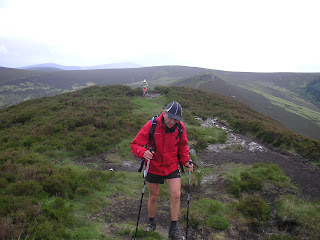
Derrybawn Ridge about 4pm
At about 4pm we were met by Paul and Isabelle on Derrybawn. At that stage we were going for about 14 hours. Big thanks to them for their support there and for sending us these photos!



Monday, May 28, 2007

Subscribe to:
Posts (Atom)
